I wanted to alert both of my faithful readers of DigitalEdu to some exciting news before it hits the media. People magazine this week lists the sexiest men alive and I moved up from 170,312,117th place to 170,312,116th! Fortunately for me, Milton Friedman recently passed away so it opened up a slot for me.
I can hardly wait for Wired magazine to come out with their "palest geek" issue. Keep your fingers crossed!

Monday, November 20, 2006


Saturday, November 11, 2006
Saturday, November 04, 2006
Agile Learning
We use an agile software development methodology called scrum in our IT department. Our consultants from Microsoft and Neudesic introduced it to us and I've become a big believer in it. I like it for a lot of reasons, but mostly for two:
 The idea behind most of the agile software development methodologies is that the traditional method (know as waterfall - see this site for a parody) was too rigid and doesn't model how the real world works.
Kathy Sierra, one of my favorite bloggers, has written a very thought provoking article where she mentions the need for Agile Learning. She points out that recent studies are showing that the skills that are taught in mathematics, science and engineering classes are not the skills that are needed in those occupations. It's good stuff and has provoked a flurry of comments. Check it out.
- Responsiveness to Users: Agile methodologies emphasize a quick turnaround between gathering requirements and getting a product in front of the users. I've found that there is nothing better than having a smart group of people beat up a prototype that we've worked on. Painful at times, but writing reams of documentation does not create good software. The only thing that creates good software is writing code while listening to the users.
- Teamwork: The methodology uses a daily meeting - called the scrum - where each member of the team reports on what was accomplished yesterday, what he/she hopes to accomplish today, and if there is anything blocking progress. The meeting is limited to 15 minutes so it does not become a big time sink. It emphasizes teamwork and accountability and I've seen it in action now for about a year. It works great.
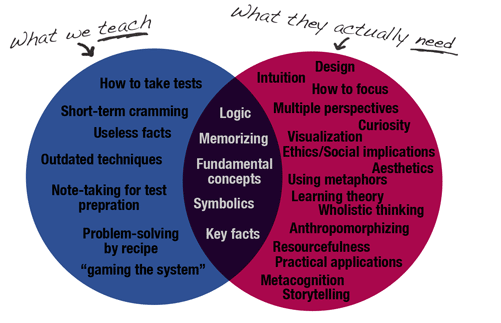 The idea behind most of the agile software development methodologies is that the traditional method (know as waterfall - see this site for a parody) was too rigid and doesn't model how the real world works.
Kathy Sierra, one of my favorite bloggers, has written a very thought provoking article where she mentions the need for Agile Learning. She points out that recent studies are showing that the skills that are taught in mathematics, science and engineering classes are not the skills that are needed in those occupations. It's good stuff and has provoked a flurry of comments. Check it out.
Saturday, October 28, 2006
Web 2.0 Tools for Educators
Brian Benzinger on a blog called "Solution Watch" has written a 3-part series on Web 2.0 sites with potential use for educators. I haven't read the entire series yet, but so far it looks like a great summary - if nothing else just for the list. Check it out.
Thursday, October 26, 2006
A Day Without the Internet
Scott Adams (author of the hilarious Dilbert comic strip) writes a funny, and at times very thoughtful, blog. He posted yesterday on what it was like without the Internet for a day. His reaction sounds very much like what mine would be (particularly when he talks about driving somewhere without checking it out first in Google Earth).
Scrybe
There is a very exciting product about to be released in a public beta. Currently you can only see it in a video, but it is already generating a lot of buzz. It is an online organizer (calendar, notes, task list, etc) and if the video is accurate, this is one of the most amazing web-based services I have seen. It is doing some things with AJAX that I have not seen anywhere else. Check it out.
Thursday, October 19, 2006
The Zone of Mediocrity
Kathy Sierra has (yet another) great post on her "Creating Passionate Users" blog regarding the Zone of Mediocrity. A definite must-read for anyone tired of doing things the usual way.
Saturday, October 14, 2006
Friday, October 13, 2006
Google Earth for Educators
There is a nice post on the Google Earth Blog regarding the use of this amazing software in education. I can't imagine teaching a class without it - I look for excuses to use it when I'm teaching the youth group at my church.
Thursday, October 12, 2006
Student Collaboration
I went to a very interesting session today from the University of Pennsylvania. They created a social bookmarking system that allows students, faculty and librarians to tag, create and share content. It was modeled after del.icio.us and it was a great example of the use of Web 2.0 technology in education.
There are some other interesting sites emerging that enable student collaboration outside of the classroom. One is stu.dicio.us which allows students to post their class notes online, and uses a tagging mechanism to link notes from the same class. Another example is NoteMesh which uses a wiki to create a collaborative work space for students to share.
There are some other interesting sites emerging that enable student collaboration outside of the classroom. One is stu.dicio.us which allows students to post their class notes online, and uses a tagging mechanism to link notes from the same class. Another example is NoteMesh which uses a wiki to create a collaborative work space for students to share.
Wednesday, October 11, 2006
Educause Day 2
Today started with a fascinating keynote from Ray Kurzweil. This is one very smart fella. He started off by reciting the past predictions he has made that came true. It sounded a lot like ego to me, so I started to check out mentally, but I realized later that he was doing it to set the stage for some remarkable predictions he made later in the presentation. He spent considerable time going through a series of slides showing the exponential growth in computing power and a similar trend downward in cost. His basic premise is that we can predict the future because the trends are exponential and predictable. Here are a few of his predictions:
It was pretty amazing stuff and if he hadn't shown how good his track record is, I might dismiss it as science fiction. Very exciting stuff!
I went to a couple of other sessions on student-centered design and open source alternatives. Another good day, but it will be good to head home tomorrow.
- Artificial red blood cells that will oxygenate your tissue so much more efficiently that you will be able to sit on the bottom of your pool for 4 hours
- Images will be sent directly to our retinas from eyeglasses and will provide a full virtual reality. Eventually neural implants will provide all of our senses with input, making the virtual world indistinguishable from the physical world.
- Computers will disappear as they are integrated into our clothing or eye glasses
- Full reverse engineering of the human brain
- Computers passing the Turing Test.
- Non biological intelligence
- Human life expectancy will accelerate rapidly in our lifetime - adding a year to the average life for each year of development after they completely decipher the human genome
- The Olympics will be cancelled because advances in biological sciences will make human bodies perform in ways we cannot even imagine now
It was pretty amazing stuff and if he hadn't shown how good his track record is, I might dismiss it as science fiction. Very exciting stuff!
I went to a couple of other sessions on student-centered design and open source alternatives. Another good day, but it will be good to head home tomorrow.
Tuesday, October 10, 2006
Educause Day 1

I'm at the Educause conference and had a good day today. Here are the highlights:
Vinton Cerf gave the keynote speech and it was pretty interesting. His basic premise is that the term "computer science" is a misnomer because virtually none of the principles of science apply to software development. We can't predict how many bugs will be in software, how bad they will be, or how to effectively eliminate them from future code. He had a really good point, but didn't really offer a solution to it. He used the term "iPod Generation" which I have been using for a couple of years in various presentations. I thought about suing him for copyright infringement, but seeing that he invented the Internet, I thought I would cut him a little slack.
I went to a fascinating session on using gaming as an educational mechanism. The University of North Carolina at Greensboro created an economics course that is presented as a video game. The quality was amazing - it was exciting to see people in higher education doing something so innovative and responsive to this generation of students. This is something that Marc Prensky has been talking about for some time now.
I did a presentation on our new system - My Academic Plan (MAP). I had a good audience and had some very positive feedback. (And yes, I once again made a shameless plug for this blog, so if you are reading this as a result - welcome.)
The last session was a very thought provoking discussion of a growing movement in higher ed to create a next generation community source Student Services System (SSS). I loved their emphasis on service and the need to create a robust, extensible framework to offer high quality services to students. It gave me a lot to think about.
This was the best day I've had at a conference in a long time. Looking forward to tomorrow...
Mexico the Sequel
Back in April I posted about a trip to Mexico I took with the youth group from my church. Our students formed a real bond with Julio and Laura and their kids and our kids wanted to do even more for them. I figured over time the memory would fade and our students would move on to other ideas. I was wrong.
 They raised $465 from the youth group and wanted to go back down to Mexico to buy the family a bed and anything else they needed. So on Saturday we headed south again and, once again, it was a wonderful experience. It turned out to be Julio's birthday so it was a great surprise for them to see us (we had no way to get hold of them ahead of time so just had to hope they would be home). We were able to buy them a bunk bed for the kids, a dresser for the whole family and bags of food. Laura and Julio cooked us a delicious meal and we got to sit in the house that we built - and that they turned into a home. It felt like a big family - American and Mexican.
I had a busy week last week and another one ahead of me so frankly I really didn't want to spend the whole day on the road, but I was so glad I did. It's such a great experience seeing a group of teenagers doing something so completely selfless. It did my heart good.
And, I got to be geeky also! When we go down to build houses, the logistics are handled by the people at Amor Ministries. This time we were on our own and had to find their house which is on a dirt road somewhere between Tecate and Tijuana. Fortunately I had marked the location of the house in my GPSr and used Google Earth to figure out which roads to take to get there. Then I found a great little program called GEtrax which allowed me to track our position in real time in Google Earth on my laptop (it used cached images since I had no Internet connection). It was great technology used for a great cause.
 They raised $465 from the youth group and wanted to go back down to Mexico to buy the family a bed and anything else they needed. So on Saturday we headed south again and, once again, it was a wonderful experience. It turned out to be Julio's birthday so it was a great surprise for them to see us (we had no way to get hold of them ahead of time so just had to hope they would be home). We were able to buy them a bunk bed for the kids, a dresser for the whole family and bags of food. Laura and Julio cooked us a delicious meal and we got to sit in the house that we built - and that they turned into a home. It felt like a big family - American and Mexican.
I had a busy week last week and another one ahead of me so frankly I really didn't want to spend the whole day on the road, but I was so glad I did. It's such a great experience seeing a group of teenagers doing something so completely selfless. It did my heart good.
And, I got to be geeky also! When we go down to build houses, the logistics are handled by the people at Amor Ministries. This time we were on our own and had to find their house which is on a dirt road somewhere between Tecate and Tijuana. Fortunately I had marked the location of the house in my GPSr and used Google Earth to figure out which roads to take to get there. Then I found a great little program called GEtrax which allowed me to track our position in real time in Google Earth on my laptop (it used cached images since I had no Internet connection). It was great technology used for a great cause.
Wednesday, October 04, 2006
Emerging Technologies
I ran across an interesting article today on one of the tech sites. It is an interview with Jason Pontin from MIT on some of the emerging technologies that are not IT related. There is a lot of fascinating stuff going on out there - check it out.
Saturday, September 30, 2006
Friday, September 29, 2006
Geocaching
One of my hobbies that I have done for a while is geocaching. I mentioned this to some friends the other day, and I was surprised they had never heard of it, so I figured it was a subject worth a post.
Geocaching is basically a high-tech treasure hunt. People all over the world are hiding small waterproof containers and then posting the GPS coordinates on web sites like geocaching.com. You can go to the site, enter your zip code, and get a list of hidden caches near you. You will be amazed how many there are (right now there are 6,540 within a 50 mile radius of my house). Using a GPS receiver (can be purchased for about a 100 bucks) you can follow the coordinates and hunt for the hidden treasure. Most caches contain a log book to sign, and many have little trinkets that you can take - as long as you put something of yours in to replace it.
It was started in May 2000 by Dave Ulmer in Oregon and has spread rapidly - there are currently over 317,000 caches around the world. One of the things I like about it is that it helps me find interesting places that I probably would never have seen. Most caches are placed in a site that has some kind of intrinsic value. It might be a beautiful view, or a hidden stream, or historical interest, but there is usually something worthwhile about the location other than the hidden cache. It's a great combination of mystery, exercise and geekiness.
A lot more information can be found (as always) on the Wikipedia page.
Geocaching is basically a high-tech treasure hunt. People all over the world are hiding small waterproof containers and then posting the GPS coordinates on web sites like geocaching.com. You can go to the site, enter your zip code, and get a list of hidden caches near you. You will be amazed how many there are (right now there are 6,540 within a 50 mile radius of my house). Using a GPS receiver (can be purchased for about a 100 bucks) you can follow the coordinates and hunt for the hidden treasure. Most caches contain a log book to sign, and many have little trinkets that you can take - as long as you put something of yours in to replace it.
It was started in May 2000 by Dave Ulmer in Oregon and has spread rapidly - there are currently over 317,000 caches around the world. One of the things I like about it is that it helps me find interesting places that I probably would never have seen. Most caches are placed in a site that has some kind of intrinsic value. It might be a beautiful view, or a hidden stream, or historical interest, but there is usually something worthwhile about the location other than the hidden cache. It's a great combination of mystery, exercise and geekiness.
A lot more information can be found (as always) on the Wikipedia page.
Friday, September 08, 2006
Blackboard Patent
Blackboard was recently awarded a patent covering Learning Management Systems (LMS) and has launched their first lawsuit against Desire2Learn - one of their only existing commercial competitors (since they purchased WebCT last year - their only significant competitor).
I'm no patent lawyer, but this whole thing smells really bad to me. There is a big difference between a copyright which protects your intellectual property (the expression of an idea) and a patent - which can protect the idea itself. The academic community should be very concerned about this action which is obviously intended to stifle competition and will (in my opinion) ultimately stifle innovation.
I have been a Blackboard administrator since 1999. I first saw Blackboard at CAUSE98 in Seattle when they were one of the small startup companies with a very small booth in the back. Overall I have been pleased with their product - I think it does the job well and despite a few bumps along the way I have been satisfied with the service we have received from them. However I have not seen anything groundbreaking or innovative that warrants a patent that would prohibit others from using the same idea. Did they invent a discussion board? Or delivering files through the web? Or online tests?
It's a good product, and virtually everyone I have dealt with at Blackboard has been great, but I think they have made a big mistake with this action. The higher education community is not a typical business market and will not react the same. This looks like a decision made by a lawyer, not a technologist or academic. There was already a movement away from commercial LMS toward open source (Moodle and Sakai) and I think this is just going to accelerate that process.
The academic blogosphere is pretty active about this, and I haven't seen anything positive about it. You can see the latest here. The president of Educause sent out a letter yesterday on this topic - you can read it here.
I'm no patent lawyer, but this whole thing smells really bad to me. There is a big difference between a copyright which protects your intellectual property (the expression of an idea) and a patent - which can protect the idea itself. The academic community should be very concerned about this action which is obviously intended to stifle competition and will (in my opinion) ultimately stifle innovation.
I have been a Blackboard administrator since 1999. I first saw Blackboard at CAUSE98 in Seattle when they were one of the small startup companies with a very small booth in the back. Overall I have been pleased with their product - I think it does the job well and despite a few bumps along the way I have been satisfied with the service we have received from them. However I have not seen anything groundbreaking or innovative that warrants a patent that would prohibit others from using the same idea. Did they invent a discussion board? Or delivering files through the web? Or online tests?
It's a good product, and virtually everyone I have dealt with at Blackboard has been great, but I think they have made a big mistake with this action. The higher education community is not a typical business market and will not react the same. This looks like a decision made by a lawyer, not a technologist or academic. There was already a movement away from commercial LMS toward open source (Moodle and Sakai) and I think this is just going to accelerate that process.
The academic blogosphere is pretty active about this, and I haven't seen anything positive about it. You can see the latest here. The president of Educause sent out a letter yesterday on this topic - you can read it here.
Monday, September 04, 2006
Dropping Knowledge
I ran across an interesting site today called DroppingKnowledge.com. They are collecting questions from people all over the world and they are going to present the top 100 questions to a group of 112 people sitting around the world's largest table in Berlin on September 9th. I have a couple of reactions to this idea.:
1) The first is what an amazing tool the Internet is for such a project. Imagine attempting a feat like this just a short while ago before the Internet became ubiquitous. Now we can have people all over the world submit questions, edit them, vote on them and begin a global conversation that could become the genesis for a new age of cross cultural cooperation. This humble little effort just might usher in a new era of peaceful co-existence.
2) My second thought is what a total crock this whole thing is. Maybe I'm a bit cynical (you wouldn't be the first person to accuse me of it), but this looks to me like the world's largest committee. Ever been on a committee? Ever see anything worthwhile come out of a committee? I also can't help wonder about the political agenda of the organizers when I see that Cindy Sheehan is a participant. Is she really one of the 112 world's greatest thinkers, or does she represent a political philosophy that they want publicized? Hey - I'm just asking questions!
The group seems very heavily weighted toward writers, poets and artists. I have nothing against those vocations, but wouldn't it have made more sense to get people together who have actually solved problems instead of just asked the questions? I suspect this group would find any corporate executive suspect, but somebody who has actually met a payroll might have some insights into solving poverty. Of course, someone in that line of work might not be able to get the day off to sit around a big table solving the world's problems with DJ Spooky.
Here are a few of my favorite questions posed on the site so far (and no, I'm not making these up - typos were left intact):
1) The first is what an amazing tool the Internet is for such a project. Imagine attempting a feat like this just a short while ago before the Internet became ubiquitous. Now we can have people all over the world submit questions, edit them, vote on them and begin a global conversation that could become the genesis for a new age of cross cultural cooperation. This humble little effort just might usher in a new era of peaceful co-existence.
2) My second thought is what a total crock this whole thing is. Maybe I'm a bit cynical (you wouldn't be the first person to accuse me of it), but this looks to me like the world's largest committee. Ever been on a committee? Ever see anything worthwhile come out of a committee? I also can't help wonder about the political agenda of the organizers when I see that Cindy Sheehan is a participant. Is she really one of the 112 world's greatest thinkers, or does she represent a political philosophy that they want publicized? Hey - I'm just asking questions!
The group seems very heavily weighted toward writers, poets and artists. I have nothing against those vocations, but wouldn't it have made more sense to get people together who have actually solved problems instead of just asked the questions? I suspect this group would find any corporate executive suspect, but somebody who has actually met a payroll might have some insights into solving poverty. Of course, someone in that line of work might not be able to get the day off to sit around a big table solving the world's problems with DJ Spooky.
Here are a few of my favorite questions posed on the site so far (and no, I'm not making these up - typos were left intact):
- Do fish feel thirst?
- Why the Human Being is so stupid?
- What is the significance of pareidolia?
- Will managers with MBA's suck the soul out of business and society to the point where there is a revolt by worker and consumer?
- why?
- How long will the hype around this service last after the meeting has passed?
- why is it so hard and complicated to mentally handle a broken-up relationship?
- Who cares for growing and CONNECTING the tools and methods of collective intelligence and wisdom into a people-powered ecosystem of solutions, complex enough to match the complexity of our world problematique? (This is NOT a rhetorical question.)
- If trees spoke, would they tell us another history?
- Might the Q/A or Problem/Solution process divert us from seeking unifying synergy within our vast diversity of cognitive/affective competencies? Might we interact as if we have no adequate expertize, but have the potential to gain what we need?
- Do I have to patent myself or my dna genes, that noone takes my dna and clones me?
- how does sewage affect algae growth?
- Why does one sock always disappear in the laundry? Where are they?
- Why is "pair of pants" plural, but "bra" is singular?
- Why is there air?
- If a mute swears, does his mother wash his hands with soap?
- What's another word for synonym?
- If a man speaks in the forest and there is no woman to hear him, is he still wrong?
- What should you do when you see an endangered animal that is eating an endangered plant?
Thursday, August 31, 2006
Oops!
This is one of those situations that is very funny - as long as it happens to someone else. A CNN anchor had her microphone on and was talking to someone in the bathroom. The sound feed was played live on top of a speech from George Bush. Fortunately for her, she said some very nice things about her husband, but unfortunately for family relations, she called her sister-in-law a "control freak". Thanksgiving dinner should be a fun time in that house this year.
You can watch the clip at YouTube.
You can watch the clip at YouTube.
Monday, August 28, 2006
Google vs. Microsoft Heating Up
Google just announced their first shot at taking on Microsoft Office. They are offering a free service designed for small and medium sized businesses to host email, chat, calendar and web page creation. Word processing and spreadsheets will be rolled in soon. This is going to be very interesting and I think is a harbinger of things to come. Instead of having huge, bloated programs installed on our PCs, I think we'll be consuming software as subscribed services. We'll only pay for the functions we use, and upgrades will be handled by the hosting service. Keep your eyes on this...
More details here.
More details here.
Subscribe to:
Posts (Atom)