I've added a new feature to DigitalEdu called "Edublogs I Read". It's a list of links to other blogs that deal with education and technology. One of the things I love about blogging is the rich resource it provides to people who are interested in learning. These are all blogs that I read on a regular basis and often learn a lot from them. Hope you enjoy them also. I'll update the list as I find new blogs worth reading.
Happy New Year!

Sunday, December 31, 2006


Monday, December 18, 2006
Time Magazine Person of the Year

Time magazine announced their annual "Person of the Year" and it's you. That's right. You are the person of the year. The cover on the physical magazine (yes - I don't just read blogs) even has a mirror on it so when you look at it you see yourself. Of course, if you are just reading blogs and not writing your own, then they are really talking about me and not you (so start writing!). To be factually accurate (a raison d’être* of DigitalEdu) it's not a mirror but a piece of reflective mylar that creates a rather disturbingly distorted image of one's face. Frankly, it's a bit of a hoot to see myself move from a pinhead (magazine in a convex shape) to a multi-headed monster (slightly concave).
The editors at Time have recognized the fairly dramatic change that has taken place on the Internet in the last couple of years as the web has shifted from a producer/consumer model of information flow to a more participatory architecture. It has been dubbed Web 2.0 and blogs, wikis and RSS are emerging from the geek ghetto into the mainstream of American culture. It is shifting the national dialogue away from the powerful elite toward - well - toward anyone who has an opinion and doesn't mind sharing it. Evidently, that is a whole lot of people. According to my favorite blog search/index site, Technorati, every day about 100,000 new blogs are created and 1.3 million new blog postings are created. That's a lot of dialogue.
The timing of this article in Time is perfect because in January I'm speaking during our faculty in-service on this very issue. I'm doing a presentation called "Geek Report: Web 2.0" at the Chancellor's In-Service session and then at each campus I'm doing a session called "Everything You Always Wanted to Know About Blogging - But Were Afraid to Ask". I've been working on the presentations the last few days and I was beginning to worry that the topics might be a bit on the geeky side. Now, thanks to Time - I'm mainstream USA!
* Look it up
Sunday, December 17, 2006
Edublog Awards
I didn't realize it until recently, but someone is giving out awards for educational blogging. I think it's a bit odd to turn blogging into a competitive sport and would rather not participate in such an unsavory activity (in other words, I didn't win anything). You should be able to find some good information by visiting the winners.
I've been using the Google Reader site to keep track of blogs and it's amazing how quickly my list grows. I'm subscribed to over 70 blogs - about 11 of them are dedicated purely to educational technology. The Google Reader is a great service and makes it very easy to skim through articles until one catches my eye.
I've been using the Google Reader site to keep track of blogs and it's amazing how quickly my list grows. I'm subscribed to over 70 blogs - about 11 of them are dedicated purely to educational technology. The Google Reader is a great service and makes it very easy to skim through articles until one catches my eye.
Monday, December 04, 2006
CASFAA Conference
I gave my "iPod Generation" presentation at the CASFAA conference in Ontario today. It was a great group - very interested and engaged in what I had to say. I have been giving this presentation for about a year and a half now, and each time I always ask questions such as "How many people have an IM screen name?" or "How many people have used Wikipedia or Google Earth?". The largest percentage of people who would raise their hand before today was about 1/3 of the audience, but today I had half or more respond positively. I figure this is due to one of the following possible reasons:
- The technology is working its way into the mainstream
- This audience was younger and more open to trying new technology (hence the iPod Generation)
- Financial Aid people are very hip
Web 2.0 Awards
David Barkol, one of our amazing Neudesic consultants, sent me a link to a site that lists Web 2.0 award winners. If you want to see the sites that are the very best of Web 2.0, check it out.
Sunday, December 03, 2006
John Seely Brown on Web 2.0 and Education
There is a nice article on the CNET web site that quotes John Seely Brown on how Web 2.0 technologies can impact education. The quote I liked the best:
Rather than treat pedagogy as the transfer of knowledge from teachers who are experts to students who are receptacles, educators should consider more hands-on and informal types of learning. These methods are closer to an apprenticeship, a farther-reaching, more multilayered approach than traditional formal education, he said.
Mohammed Aref
There is an amazing article on the front page of the LA Times today regarding a teacher in Afghanistan by the name of Mohammed Aref. The Taliban have been making a resurgence in the area in which he was teaching, and he had been warned through a "night letter" attached to his house that he needed to stop teaching. He chose to ignore the warning and about two weeks later a man on a motorcycle drove into the schoolyard and fired six shots into the teacher from an AK47. The article stated:
It's interesting to me that those who want to impose tyranny on a population see education as a threat. If your ideas can not stand the test of critical thinking, and you cannot bring yourself to reexamine those ideas, then I suppose it makes sense (in a sick and twisted way) to eliminate those who would teach people to think.
Ultimately I think that is what education is all about. Not just teaching a set of facts to be memorized, but to train people to think critically and to challenge the ideas of the status quo. I'm proud to be working in an industry that has that as its "end product". Let's hope that people like Mohammed Aref are able to succeed and train children who can think for themselves.
Aref had no way to defend himself. His only weapons were his faith in knowledge, some tattered books and a piece of chalk. He died in the dirt in front of horrified pupils.What an amazing man. He chose to place the education of children over his own life. The article went on to describe a number of other educators in the same life-threatening situation. One woman has taken to carrying a pistol with her at all times to defend herself.
It's interesting to me that those who want to impose tyranny on a population see education as a threat. If your ideas can not stand the test of critical thinking, and you cannot bring yourself to reexamine those ideas, then I suppose it makes sense (in a sick and twisted way) to eliminate those who would teach people to think.
Ultimately I think that is what education is all about. Not just teaching a set of facts to be memorized, but to train people to think critically and to challenge the ideas of the status quo. I'm proud to be working in an industry that has that as its "end product". Let's hope that people like Mohammed Aref are able to succeed and train children who can think for themselves.
Saturday, December 02, 2006
Web 2.0 and Education
There is a great article on the Educause web site regarding Web 2.0 and higher education. This is a topic that I've been thinking of a lot lately and plan on speaking about it during our in-service week in January.
Monday, November 20, 2006
Progress!
I wanted to alert both of my faithful readers of DigitalEdu to some exciting news before it hits the media. People magazine this week lists the sexiest men alive and I moved up from 170,312,117th place to 170,312,116th! Fortunately for me, Milton Friedman recently passed away so it opened up a slot for me.
I can hardly wait for Wired magazine to come out with their "palest geek" issue. Keep your fingers crossed!
I can hardly wait for Wired magazine to come out with their "palest geek" issue. Keep your fingers crossed!
Saturday, November 11, 2006
Saturday, November 04, 2006
Agile Learning
We use an agile software development methodology called scrum in our IT department. Our consultants from Microsoft and Neudesic introduced it to us and I've become a big believer in it. I like it for a lot of reasons, but mostly for two:
 The idea behind most of the agile software development methodologies is that the traditional method (know as waterfall - see this site for a parody) was too rigid and doesn't model how the real world works.
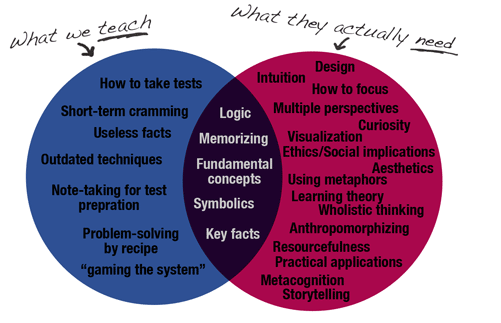
Kathy Sierra, one of my favorite bloggers, has written a very thought provoking article where she mentions the need for Agile Learning. She points out that recent studies are showing that the skills that are taught in mathematics, science and engineering classes are not the skills that are needed in those occupations. It's good stuff and has provoked a flurry of comments. Check it out.
- Responsiveness to Users: Agile methodologies emphasize a quick turnaround between gathering requirements and getting a product in front of the users. I've found that there is nothing better than having a smart group of people beat up a prototype that we've worked on. Painful at times, but writing reams of documentation does not create good software. The only thing that creates good software is writing code while listening to the users.
- Teamwork: The methodology uses a daily meeting - called the scrum - where each member of the team reports on what was accomplished yesterday, what he/she hopes to accomplish today, and if there is anything blocking progress. The meeting is limited to 15 minutes so it does not become a big time sink. It emphasizes teamwork and accountability and I've seen it in action now for about a year. It works great.
 The idea behind most of the agile software development methodologies is that the traditional method (know as waterfall - see this site for a parody) was too rigid and doesn't model how the real world works.
Kathy Sierra, one of my favorite bloggers, has written a very thought provoking article where she mentions the need for Agile Learning. She points out that recent studies are showing that the skills that are taught in mathematics, science and engineering classes are not the skills that are needed in those occupations. It's good stuff and has provoked a flurry of comments. Check it out.
Saturday, October 28, 2006
Web 2.0 Tools for Educators
Brian Benzinger on a blog called "Solution Watch" has written a 3-part series on Web 2.0 sites with potential use for educators. I haven't read the entire series yet, but so far it looks like a great summary - if nothing else just for the list. Check it out.
Thursday, October 26, 2006
A Day Without the Internet
Scott Adams (author of the hilarious Dilbert comic strip) writes a funny, and at times very thoughtful, blog. He posted yesterday on what it was like without the Internet for a day. His reaction sounds very much like what mine would be (particularly when he talks about driving somewhere without checking it out first in Google Earth).
Scrybe
There is a very exciting product about to be released in a public beta. Currently you can only see it in a video, but it is already generating a lot of buzz. It is an online organizer (calendar, notes, task list, etc) and if the video is accurate, this is one of the most amazing web-based services I have seen. It is doing some things with AJAX that I have not seen anywhere else. Check it out.
Thursday, October 19, 2006
The Zone of Mediocrity
Kathy Sierra has (yet another) great post on her "Creating Passionate Users" blog regarding the Zone of Mediocrity. A definite must-read for anyone tired of doing things the usual way.
Saturday, October 14, 2006
Friday, October 13, 2006
Google Earth for Educators
There is a nice post on the Google Earth Blog regarding the use of this amazing software in education. I can't imagine teaching a class without it - I look for excuses to use it when I'm teaching the youth group at my church.
Thursday, October 12, 2006
Student Collaboration
I went to a very interesting session today from the University of Pennsylvania. They created a social bookmarking system that allows students, faculty and librarians to tag, create and share content. It was modeled after del.icio.us and it was a great example of the use of Web 2.0 technology in education.
There are some other interesting sites emerging that enable student collaboration outside of the classroom. One is stu.dicio.us which allows students to post their class notes online, and uses a tagging mechanism to link notes from the same class. Another example is NoteMesh which uses a wiki to create a collaborative work space for students to share.
There are some other interesting sites emerging that enable student collaboration outside of the classroom. One is stu.dicio.us which allows students to post their class notes online, and uses a tagging mechanism to link notes from the same class. Another example is NoteMesh which uses a wiki to create a collaborative work space for students to share.
Wednesday, October 11, 2006
Educause Day 2
Today started with a fascinating keynote from Ray Kurzweil. This is one very smart fella. He started off by reciting the past predictions he has made that came true. It sounded a lot like ego to me, so I started to check out mentally, but I realized later that he was doing it to set the stage for some remarkable predictions he made later in the presentation. He spent considerable time going through a series of slides showing the exponential growth in computing power and a similar trend downward in cost. His basic premise is that we can predict the future because the trends are exponential and predictable. Here are a few of his predictions:
It was pretty amazing stuff and if he hadn't shown how good his track record is, I might dismiss it as science fiction. Very exciting stuff!
I went to a couple of other sessions on student-centered design and open source alternatives. Another good day, but it will be good to head home tomorrow.
- Artificial red blood cells that will oxygenate your tissue so much more efficiently that you will be able to sit on the bottom of your pool for 4 hours
- Images will be sent directly to our retinas from eyeglasses and will provide a full virtual reality. Eventually neural implants will provide all of our senses with input, making the virtual world indistinguishable from the physical world.
- Computers will disappear as they are integrated into our clothing or eye glasses
- Full reverse engineering of the human brain
- Computers passing the Turing Test.
- Non biological intelligence
- Human life expectancy will accelerate rapidly in our lifetime - adding a year to the average life for each year of development after they completely decipher the human genome
- The Olympics will be cancelled because advances in biological sciences will make human bodies perform in ways we cannot even imagine now
It was pretty amazing stuff and if he hadn't shown how good his track record is, I might dismiss it as science fiction. Very exciting stuff!
I went to a couple of other sessions on student-centered design and open source alternatives. Another good day, but it will be good to head home tomorrow.
Tuesday, October 10, 2006
Educause Day 1

I'm at the Educause conference and had a good day today. Here are the highlights:
Vinton Cerf gave the keynote speech and it was pretty interesting. His basic premise is that the term "computer science" is a misnomer because virtually none of the principles of science apply to software development. We can't predict how many bugs will be in software, how bad they will be, or how to effectively eliminate them from future code. He had a really good point, but didn't really offer a solution to it. He used the term "iPod Generation" which I have been using for a couple of years in various presentations. I thought about suing him for copyright infringement, but seeing that he invented the Internet, I thought I would cut him a little slack.
I went to a fascinating session on using gaming as an educational mechanism. The University of North Carolina at Greensboro created an economics course that is presented as a video game. The quality was amazing - it was exciting to see people in higher education doing something so innovative and responsive to this generation of students. This is something that Marc Prensky has been talking about for some time now.
I did a presentation on our new system - My Academic Plan (MAP). I had a good audience and had some very positive feedback. (And yes, I once again made a shameless plug for this blog, so if you are reading this as a result - welcome.)
The last session was a very thought provoking discussion of a growing movement in higher ed to create a next generation community source Student Services System (SSS). I loved their emphasis on service and the need to create a robust, extensible framework to offer high quality services to students. It gave me a lot to think about.
This was the best day I've had at a conference in a long time. Looking forward to tomorrow...
Subscribe to:
Posts (Atom)